Last weekend I was a judge at a robot competition.
This was my first time. A friend who was organizing the event asked if I would be willing to spend a day judging robot teams and I had to say, “yes!”
FIRST (For Inspiration and Recognition in Science and Technology) is a global nonprofit founded in 1989 which engages students around the world, inspiring them to build robots and compete in team robot challenges.

The competition I judged was a “FIRST Tech Challenge” (FTC) for students from 7th to 12th grade and took place at Hillsboro High School. Student teams from Salem, Portland, Beaverton, West Linn, Cornelius and other cities attended. In total, there were about 20 teams consisting of four to over a dozen members.
Last September, the rules of the robot challenge were published. That gave teams only a few months to build, program, and perfect their robots. At the most basic level, this game required robots to collect “pixels” (plastic hexagons) from one corner of the arena and stack them on a board at the opposite corner. But there were several optional ways to score bonus points. Here is a 6-minute video describing the rules of the challenge, which are surprisingly complex.
The Game
Each match lasts 2.5 minutes. For the first 30 seconds, the robots may operate autonomously (if so built and programmed) and score points. At the 30 second mark, “drivers” pick up their controllers and take active command of their robots. Four robots are in the arena at a time. Teams are randomly paired together. For two and a half minutes, these teams work together to score the most points.

Judging
Each team is interviewed, and their robots inspected to make sure they comply with the rules. The teams provide judges with portfolios describing their team and the journey they went through designing, building, and perfecting their robots. Multiple categories are available for awards, both technical and non-technical.
The latter is where I came in. Although I work in Information Technology, I am neither an engineer nor a programmer, and I have never built or controlled a robot. So, I was assigned to judge teams in two non-technical categories: “Connect” and “Motivate.” Each team is encouraged to do outreach to foster more interest and participation in STEM (Science, Technology, Engineering, and Math), raise funds, and serve their communities.

One after another, each team marched in, gave us a 5-minute presentation introducing themselves and their robot followed by about 10 minutes of questions from the judges. After seeing all our teams, the judges shared notes and compiled follow-up questions. We then visited those teams back at the “pit” area where they prepared (and sometimes repaired) their robots for their next matches.

Overall, the number one value of this entire competition is Gracious Professionalism®. One question I asked each team is what this term meant to them and how their team embodied this value. Their answers were thoughtful and inspiring.
In between interviews I was able to catch a match or two. Announcers called out robot numbers, noting scoring attempts and actions. Cheers and shouts of encouragement echoed through the hall just like you might hear at football or other sporting event.
Awards Ceremony
The judging scores were compiled and ranked just as the final matches were completed and the game arenas dismantled. Teams of students and their parents waited anxiously as the judges filed out of our room to present the awards.
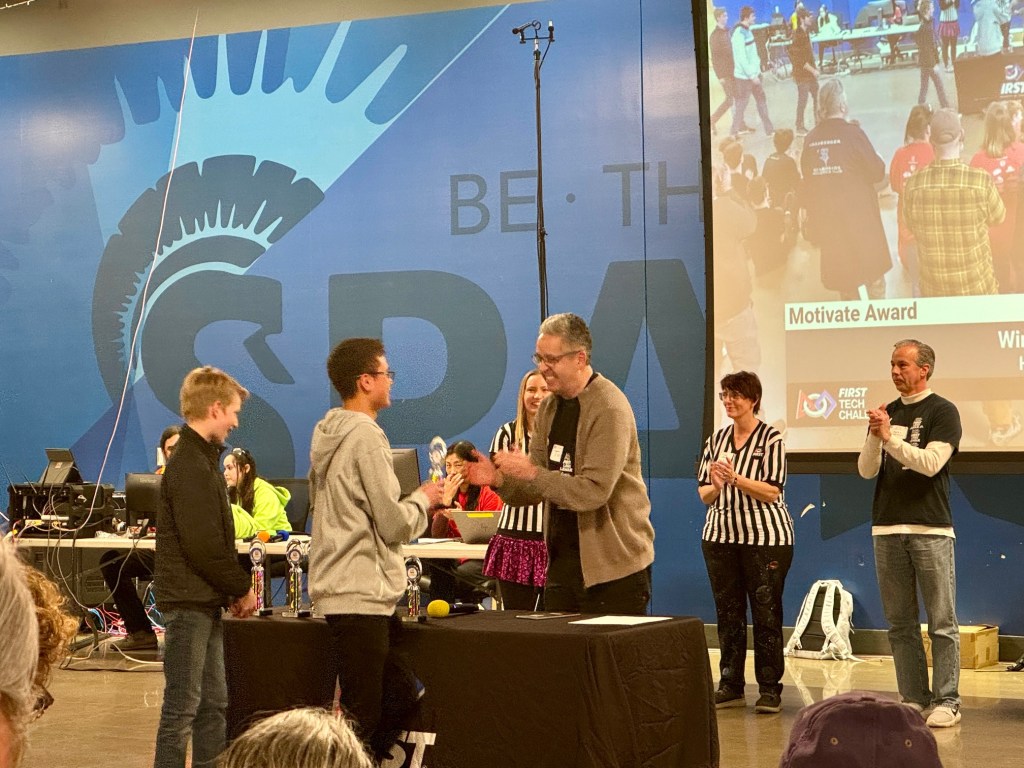
We judges took turns announcing each award category and winners. After collecting their awards, the winning teams passed the line of judges receving congratulatory high-fives.

Conclusion
The day was long yet exhilarating. I was amazed and inspired by the tremendous achievements of these kids — even those teams whose robots weren’t able to accomplish everything they attempted or who failed mid-competition. The cheers that erupted from the crowd were just as enthusiastic and fervent as at any athletic competition, and the genuine camaraderie and support between the teams was moving.

Back when I was in high school, the closest thing to celebrated academic competition was College Bowl.
The level of technical challenge, the fund raising, and community outreach displayed by these kids really gives me excitement and optimism for the future, which is in the hands of these young engineers and scholars.
If this sounds interesting to you, there is no shortage of opportunity to take part. Volunteers are needed at all levels (much more than just judging). Sponsorship and mentoring plays a huge role in the success of this endeavor. Check out the FIRST website and/or talk to people at your area schools to see if they participate in this program and what, if anything you can do to contribute and support.
Postscript
My friend coaches 8610 ToborTech, a team which last Saturday scored the 5th highest score in the world and 2nd highest in the U.S. Here you can see the amazing match:
 Blatant Calm