We came aboard and slept Sunday night in Rostock, Germany. All our food was delivered the next morning, which took a while to inventory and find places to store in the fridges and dry storage containers.
Loading our food in Rostock (note the delivery truck in the background)
Winds were light and unfavorable, so we motored up the Warnow river to Warnemünde, and then northeast to Wustrow, anchoring offshore. A few of us were taxied in a dinghy to shore to stroll the beach and a little of the coastal town during sunset. The sunset was gorgeous!
Stein quickly motors us to shoreThe beach at WustrowOur first look at thatched roofsAbel Tasman in the sunset
Far from big cities, the sky was dark and perfect for stargazing. Staying up late, we saw several great meteors from the Perseid shower and a constant string of satellites crisscrossing the Milky Way. A dull light grey haze on the horizon I assumed to be glare from city lights. But photographs taken revealed brilliant colors our eyes could not perceive of the Aurora Borealis.
Our masts reach for the Milky WayAurora Borealis, which to my eyes looked like a gray haze on the horizon
Most of us sailed last year and have been quick studies learning/relearning the sails and lines. We hoisted and set sails like experienced hands under the supervision of the crew. I spent an hour or two on the wheel on the first day.
Identifying and naming the sales drawn in chalkHoisting the main sailTaking the wheel
Like last year, I took advantage of the light winds and smooth seas to scale the 95-foot mast. Several followed me to the dizzying height.
This year’s crew was all Dutch captained by the ship’s owner. Most spoke German, though a couple prefer English. Everyone on board, passenger and crew spoke English and readily used it when desired. I translated as much as I could on the fly.
I went sailing again on the Abel Tasman, a 111 year old, 133-foot long, twin masted Dutch schooner.
I wrote a 7-part blog series about my voyage last year. We all had such a good time, we urged our host to do it again. So, my friend, Frank, indulged us and organized another trip.
Last year we had 17 passengers. This year, all but one returned, and our numbers swelled to 22 as partners, children, and a few new friends joined us.
I was especially excited since this year the Abel Tasman would be departing from Rostock, a former East German city I had studied in 35 years ago before the fall of the Berlin Wall. I have a blog devoted to memories from that extraordinary experience. This would be my first time returning to that city.
Starting with several emails I wrote during the trip, I have edited, expanded, and added photographs to create this blog series.
Last year I had the wonderful experience sailing the Baltic Sea on a twin masted schooner, the Abel Tasman. I wrote about it in a 7-part blog series.
We all had such a good time we persuaded our host and my friend, Frank, into doing it again!
So. we’ll be setting sail in just a few weeks from Rostock, the former East German city in which I spent one semester studying before the fall of the Berlin Wall. I’ve blogged about my memories of that extraordinary experience as well.
We will embark on Sunday, Aug 11 and return to Rostock a week later on Aug 18.
Location of the Abel Tasman as of this writing
As of this writing, the Abel Tasman set sail yesterday from Brest, France and is making her way up to the Netherlands, Denmark and eventually to Rostock.
We won’t know where we are sailing from day to day. On a typical morning, we will eat breakfast, and the captain will announce the forecasted winds and currents and show us a chart with possible destinations.
Last weekend I played principal viola in a concert with the Oregon East Symphony (OES).
Although I have performed for over two decades with the Newport Symphony and occasionally subbed with other orchestras (such as OES), I’ve only played principal viola once before last week.
What is a Principal Musician?
The principal is the leader of a section of instruments. There is a principal cello, principal viola, principal 2nd violin, as well as principal percussion, horn, etc. The principal 1st violin is called the concert master and has additional responsibilities.
The principal leads their section. That can include assigning parts when multiple voices are written. In string sections, the principal may suggest particular bowings and fingerings. They are expected to help visually cue when the section is to start playing after a long pause in the music, and so on. Sometimes, composers may write a solo specifically for the principal musician. For this reason, the principal musician is typically the most skilled member of that section.
Accepting the Role
I knew I was not the most skilled violist in the section, and when first offered the position, encouraged them to pick someone stronger. But they insisted I was the one they wanted, so I buckled down for the task.
Rarely does the viola section get to play the melody in an orchestra. They more typically play a supporting role, offering harmony, doubling with other sections (cellos, bassoons, etc.) or the “pa pa” rhythm in a waltz “oom-pa-pa.” Once in a while, composers like Brahms and Dvořák favor the viola section with short phrases of melody. Off the top of my head, I could count on one hand the number of symphonic works I can think of that have an actual viola solo.
As luck would have it, this concert featured a rare viola solo.
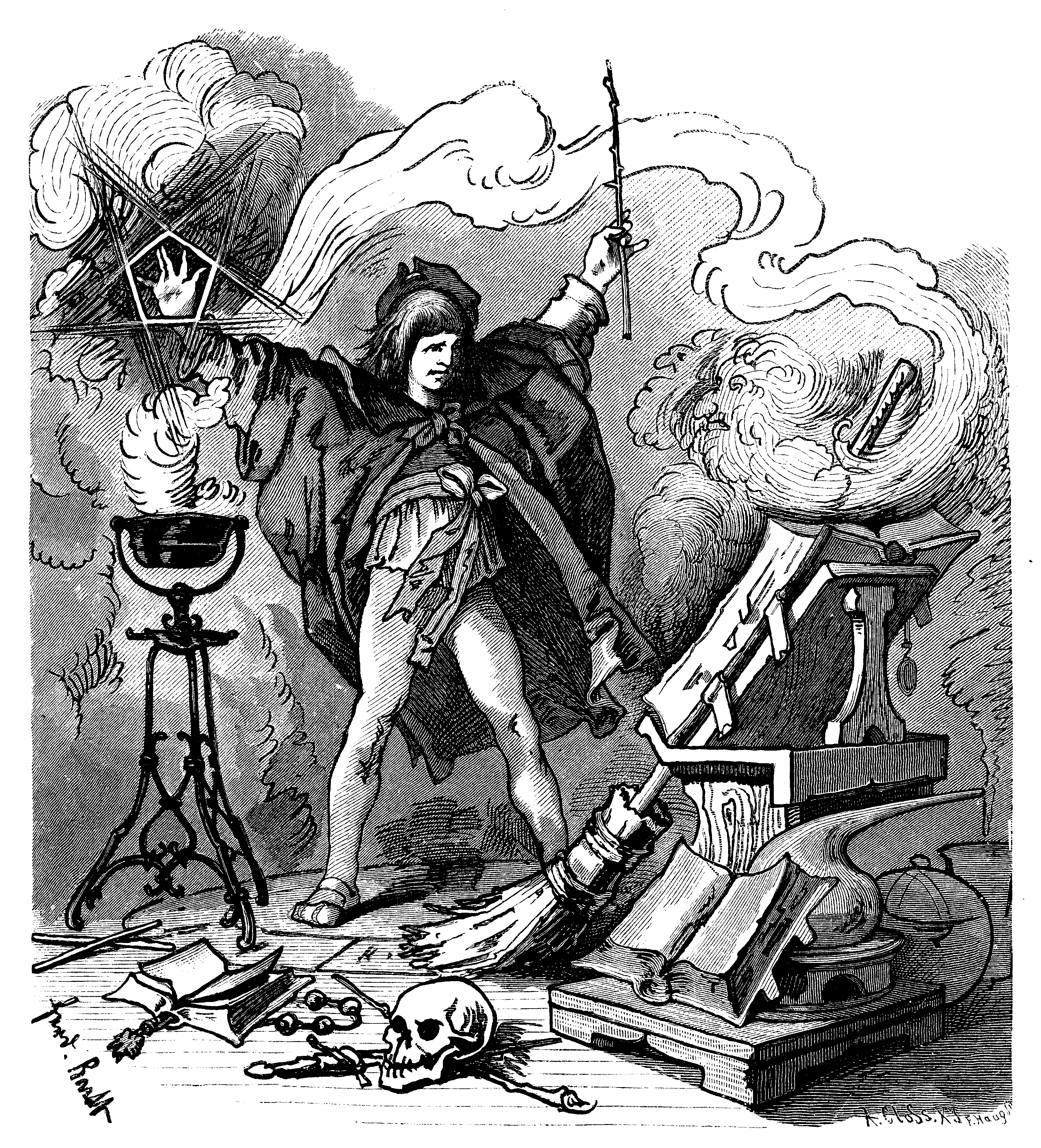
One of the pieces of the program was “The Sorcerer’s Apprentice” by Paul Dukas. Based on poem by Goethe and made popular in Walt Disney’s 1940 animated film Fantasia, it vividly depicts the story of the young sorcerer, bored and tired with his assigned of task carrying buckets of water, deciding to use magic to enchant a broom to do the work instead.
He is unable to stop the broom. He even resorts to splitting the broom with an axe only to see the individual pieces and splinters continue the work. He completely loses control of the situation and the room floods with rising water. The old sorcerer returns, and with a wave of his wand, quickly reverses the spell.
Mickey Mouse as “The Sorcerer’s Apprentice” in Disney’s Fantasia (1940)
Musically, each character in the story has a dedicated theme. The old sorcerer has an ethereal melody played by the upper strings. The enchanted broom (later brooms) has a distinctive march played by the bassoon.
After the return of the old sorcerer and his climactic spell ending the brooms’ enchantment (2:03 in the clip above), the musical theme for the old sorcerer is played (2:24), and a short, mournful melody is played on solo viola. In Disney’s Fantasia, Mickey Mouse, who plays the Sorcerer’s Apprentice returns to his mentor the magical hat while wearing a chastened and embarrassed expression (2:32). The solo viola plays its melody twice (although the second time is cut in the abbreviated Fantasia version).
Fates Collude Against Me
The week leading up to the rehearsals and concert I was alarmed to find my left ear was blocked. I tried drops to remove any ear wax, took antihistamines, and found little relief. A healthcare provider peered in my ears and perceived no infection or wax, but she did see some fluid. She recommended saline nasal rinses, nasal decongestant spray, and failing that, a nasal steroid spray (Flonase).
At first rehearsal, I could hear almost nothing out of my left ear, which is the one closest to my instrument. I couldn’t tell if I was in tune at all during the first rehearsal. It was nerve wracking!
The veritable apothecary of medications started to take effect, and as I worked through the various rehearsals, my hearing gradually improved. My friends and colleagues gave me encouragement and helpfully answered my request for feedback and advice on my solo. Come concert day, I was feeling reasonably confident.
An overdressed principal violist
I showed up in my concert tuxedo … and saw everyone was dressed in open collar black shirts. My heart sank into my stomach. Rereading an earlier email, I found the part I had missed: “For the performance, dress all in black and for comfort. Tuxedos will probably be a little too much to bear. Short sleeved shirts/sleeveless dresses are totally acceptable attire.”
Great. So, I was overdressed (and likely going to overheat).
But happily, it all worked out in the end. I was satisfied with my solo and was humbled to receive praise from several musicians and members of the audience.
Perhaps the magic of the music buoyed me in my time of need.
Last weekend I was a judge at a robot competition.
This was my first time. A friend who was organizing the event asked if I would be willing to spend a day judging robot teams and I had to say, “yes!”
FIRST (For Inspiration and Recognition in Science and Technology) is a global nonprofit founded in 1989 which engages students around the world, inspiring them to build robots and compete in team robot challenges.
The competition I judged was a “FIRST Tech Challenge” (FTC) for students from 7th to 12th grade and took place at Hillsboro High School. Student teams from Salem, Portland, Beaverton, West Linn, Cornelius and other cities attended. In total, there were about 20 teams consisting of four to over a dozen members.
Last September, the rules of the robot challenge were published. That gave teams only a few months to build, program, and perfect their robots. At the most basic level, this game required robots to collect “pixels” (plastic hexagons) from one corner of the arena and stack them on a board at the opposite corner. But there were several optional ways to score bonus points. Here is a 6-minute video describing the rules of the challenge, which are surprisingly complex.
The Game Each match lasts 2.5 minutes. For the first 30 seconds, the robots may operate autonomously (if so built and programmed) and score points. At the 30 second mark, “drivers” pick up their controllers and take active command of their robots. Four robots are in the arena at a time. Teams are randomly paired together. For two and a half minutes, these teams work together to score the most points.
The empty robot arena
Judging Each team is interviewed, and their robots inspected to make sure they comply with the rules. The teams provide judges with portfolios describing their team and the journey they went through designing, building, and perfecting their robots. Multiple categories are available for awards, both technical and non-technical.
The latter is where I came in. Although I work in Information Technology, I am neither an engineer nor a programmer, and I have never built or controlled a robot. So, I was assigned to judge teams in two non-technical categories: “Connect” and “Motivate.” Each team is encouraged to do outreach to foster more interest and participation in STEM (Science, Technology, Engineering, and Math), raise funds, and serve their communities.
Matches rotated between two robot arenas throughout the afternoon
One after another, each team marched in, gave us a 5-minute presentation introducing themselves and their robot followed by about 10 minutes of questions from the judges. After seeing all our teams, the judges shared notes and compiled follow-up questions. We then visited those teams back at the “pit” area where they prepared (and sometimes repaired) their robots for their next matches.
One robot attempts bonus points by suspending itself at the end of the match
Overall, the number one value of this entire competition is Gracious Professionalism®. One question I asked each team is what this term meant to them and how their team embodied this value. Their answers were thoughtful and inspiring.
In between interviews I was able to catch a match or two. Announcers called out robot numbers, noting scoring attempts and actions. Cheers and shouts of encouragement echoed through the hall just like you might hear at football or other sporting event.
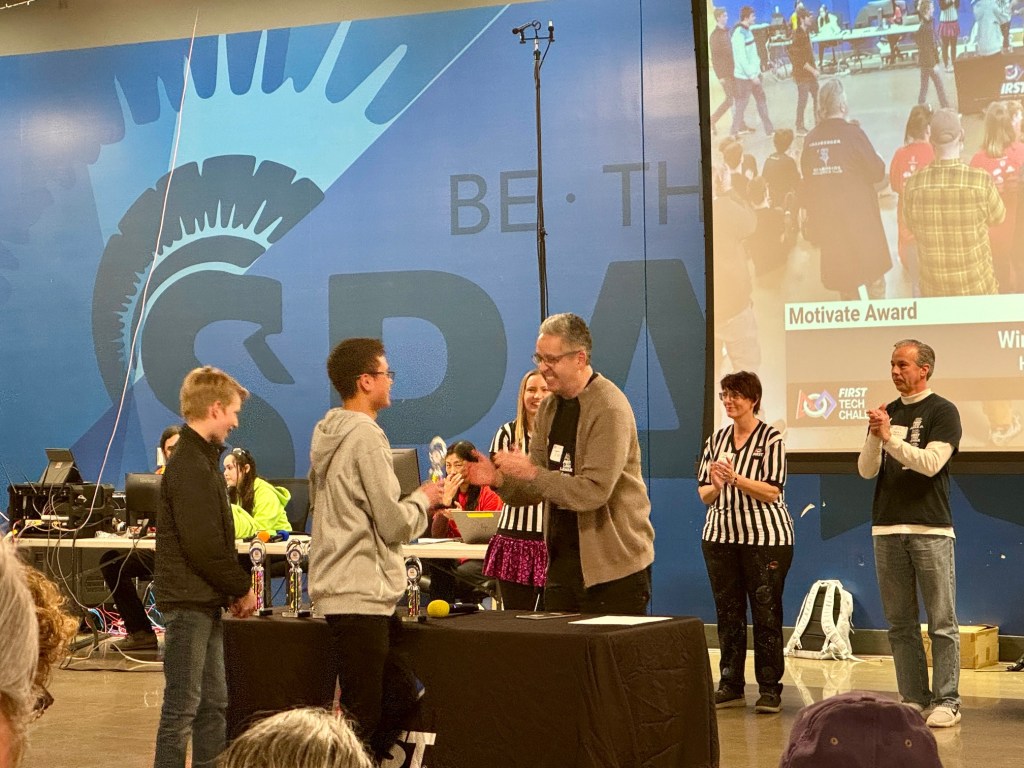
Awards Ceremony The judging scores were compiled and ranked just as the final matches were completed and the game arenas dismantled. Teams of students and their parents waited anxiously as the judges filed out of our room to present the awards.
Handing out a trophy
We judges took turns announcing each award category and winners. After collecting their awards, the winning teams passed the line of judges receving congratulatory high-fives.
Row of judges, ready to high-five (note a winning team projected above us)
Conclusion The day was long yet exhilarating. I was amazed and inspired by the tremendous achievements of these kids — even those teams whose robots weren’t able to accomplish everything they attempted or who failed mid-competition. The cheers that erupted from the crowd were just as enthusiastic and fervent as at any athletic competition, and the genuine camaraderie and support between the teams was moving.
Back when I was in high school, the closest thing to celebrated academic competition was College Bowl.
The level of technical challenge, the fund raising, and community outreach displayed by these kids really gives me excitement and optimism for the future, which is in the hands of these young engineers and scholars.
If this sounds interesting to you, there is no shortage of opportunity to take part. Volunteers are needed at all levels (much more than just judging). Sponsorship and mentoring plays a huge role in the success of this endeavor. Check out the FIRST website and/or talk to people at your area schools to see if they participate in this program and what, if anything you can do to contribute and support.
Postscript My friend coaches 8610 ToborTech, a team which last Saturday scored the 5th highest score in the world and 2nd highest in the U.S. Here you can see the amazing match:
I donate sometimes as often as every week, but more typically 2-3 times every month. I happen to have a high level of platelets, so most of the time I donate three units of platelets (and sometimes also plasma) every time I go in.
After all the times I’ve been donated, I still am fascinated by the process – and I am still learning new things about platelets. Just last month I learned that matching donated platelets with recipients is pretty complex.
Donating in Salam, OR, back in 2022
Platelets aren’t matched simply on blood type. Instead, like bone marrow transplants, platelets are tested to find the closest Human Leukocyte Antigen (HLA) match. It’s rarely 100%, but the closer the match, the better – especially for people with weakened immune systems.
What is HLA? Greatly simplified, the HLA system encodes the surface of your cells with unique proteins – rather like fingerprints for your cells. Your immune system will recognize cells with matching HLA as your own and fight off any that appear foreign.
I spotted this Red Cross Blood Drive sign in Nagoya Japan in 2016
Donated blood products with a poor HLA match really can be a risk to a patient with a weak immune system. I have been told that your healthy donation can actually attack the patient’s system.
So, platelet donations may be sent far, far away if they are a good match. A decent supply of platelets locally does not guarantee a close match.
I receive emails after my donations letting me know where my platelets have been sent. In the past year, here are all the places they ended up:
Destinations of Toby’s 2023 Platelet Donations
University of California- UCLA, Los Angeles, CA UCSF Medical Center at Mission Bay, San Francisco, CA West Los Angeles Medical Center., Los Angeles, CA Egleston Hospital, Atlanta, GA Tanner Medical Center Carrollton, Carrollton, GA Northside Hospital, Atlanta, GA University of Michigan Hospital, Ann Arbor, MI McLaren Macomb, Mount Clemens, MI Harper University Hospital, Detroit, MI MountainView Hospital, Las Vegas, NV Sunrise Hospital & Medical Center, Las Vegas, NV Kaiser Sunnyside Medical Center, Clackamas, OR Asante Rogue Regional Medical Center, Medford, OR OHSU Hospital, Portland, OR Salem Health, Salem, OR Columbia Memorial Hospital, Astoria, OR St. Charles Medical Center, Bend, OR Adventist Medical Center, Portland, OR OHSU Hospital, Portland, OR Hospital of the University of Pennsylvania, Philadelphia, PA Kadlec Regional Medical Center, Richland, WA Seattle Children’s Hospital, Seattle, WA UW Medical Center, Seattle, WA Astria Toppenish Hospital, Toppenish, WA Yakima Valley Memorial Hospital, Yakima, WA
Given platelets can only be used within a week after they are collected, it takes sophisticated logistics to match, transport, and transfuse them in time!
They are needed especially by patients with cancer or leukemia, those undergoing major operations, and those who have been in bad accidents.
There is always an urgent need for platelets. Right now, the Red Cross reports that blood supplies are currently the lowest they have been in 20 years.
My dear friend, Alicia, donating back in 2018
Platelets have higher eligibility requirements. If you are eligible, please consider donating. If you are in the Portland area, I will happily donate with you!
It’s an unfortunate truth that there are unscrupulous people who exploit others out of their money — maybe a few hundred dollars or one’s life savings. Whole organizations employ sophisticated operations to convince you or someone you love to hand over a lot of money.
The scam industry steals $20 billion a year.
I’d like to share some tips and resources for you and the people you care about, especially those 65 and older.
I. Finding Legitimate Charity Organizations
During the holiday season many people donate to charities. Unfortunately, unscrupulous organizations convince many they are doing good when they are in fact wasting or pocketing a major portion of their donations.
There are so many good causes one can donate to and there is no shortage of need. However, there is great variety in how effectively various charities spend their money. To find out how much of your donation actually goes toward the intended cause (versus administrative costs, marketing, etc.), use Charity Navigator.
Their ratings will show you how your gift can be be maximized to serve the causes you care about most.
II. Avoiding Email and Telephone Scammers
Scammers, in my opinion, are some of the most despicable individuals. A single scam call center can swindle up to $60,000 per day, and they target mostly senior citizens — 90% of their money is stolen from people 65 and older by exploiting their empathy and naiveté. Typically, they call only during business hours as those are the times they are most likely to catch retired people.
Scammers pretend to be from an organization you know (Apple, Microsoft, IRS, Medicare, Social Security, etc.).
Scammers say there’s a problem or a prize.
Scammers pressure you to act immediately.
Scammers tell you to pay in a specific way (cryptocurrency, cash, wire transfer, gift cards).
To avoid phone scams:
Block unwanted calls and text messages.
Don’t give out personal or financial information in response to a request you didn’t expect.
Resist the pressure to act immediately.
Know how scammers tell you to pay – be very suspicious of requests you use cryptocurrency, wire transfers, or gift cards.
Stop and talk to someone you trust – I think this is the best advice. Don’t be shy or ashamed to ask for help. If you have already paid a suspected scammer, don’t let shame prevent you from telling someone ASAP if you think you’ve been scammed. If you act quickly enough, you may be able to stop or block a payment to a scammer.
If you are interested in seeing some entertaining videos showing scammers getting caught by experienced computer experts and engineers, here are a couple:
Mark Rober (the porch pirate glitter bomb guy) made two videos. In the first, he catches a scammer trying to steal thousands of dollars:
But in doing so, he pulls back the cover on a multimillion-dollar international scamming scheme. Using a team of experts, he infiltrates and seriously pranks a large scam call center in India:
People’s Call Center 2023 A group of hackers and volunteers led by professional scam baiter Pierogi spent a week fighting back against scam call centers:
III. Detecting and Avoiding AI Voice Scams
Unfortunately, artificial intelligence (AI) technology has advanced to the level where someone’s voice can be reproduced very convincingly.
Here’s how the scam works:
People receive calls from someone who sounds like a friend or a relative urgently in need of money. This technology is called voice cloning, and it sounds amazingly authentic. Like the scammers above, they often pressure you to act immediately and to send the money via wire transfer or gift cards.
The quickest and simplest way to avoid these convincing scams is to call them back to verify.
Here’s a news story about someone who almost got scammed:
I hope this information helps keep you and those you care about safe.
If something could be repaired, I’d rather do that than buy a new one — I wouldn’t have to pay for a new microwave and its installation as well as deal with the removal and disposal of the old one. And old appliances seem to be more durably built than those today, the latter of which seem to be designed to fail after only a handful of years.
Here’s my full story:
1. Things start to go haywire: The touch pad buttons on my microwave started to act up. There is one button that turns on the light and another that turns on the exhaust fan. Sometimes, pressing the light button, the fan would come on (sometimes the light too). I’d have to press the button repeatedly until the desired combination of light and fan was achieved. It was a minor irritation.
But then the number keys started to act up. Pressing one number might work, but the numbers on the display might change to a completely different number. It was at this point I decided something needed to be done.
2. Researching the problem and possible solution The main parts of the oven (the microwave and turntable) were fine. I suspected the touchpad and/or circuitry were starting to go bad. Maybe I could replace them? (I was successful a couple years back fixing a washing machine door, which I wrote about here).
I took a picture of the label with the model (General Electric JVM1630BJ01), serial number, and manufacture date (July, 2004) and searched Google.
I quickly found a site that showed a schematic with pictures of the various parts and their part numbers. Unfortunately, my microwave was too old to find new replacement parts, but I wasn’t ready to give up just yet.
Replacement used control panel and circuit board on eBay
I noted the specific part number for the control panel and searched Google and eBay for it. I found the used part for sale on eBay. But would I be able to do the repair myself?
I next went to YouTube and searched for videos explaining how to replace the circuit board and touch pad for a GE microwave. I quickly found videos showing how to do it, and it looked like a pretty simple task: remove a couple screws to remove a vent cover, then remove another screw or two to loosen the control pad panel, disconnect some wires, then reverse the process with a replacement panel.
The used replacement circuit board/control panel was going to cost about $60. Because it was both the control panel and the circuit board, I would be able to skip a lot of the steps in the video above.
It wasn’t guaranteed to work, but I had decent confidence it would. And it would be a lot cheaper and less time-consuming than buying a new microwave and doing the removal of the old and installation of the new. I decided to take the gamble and give it a try.
3. Taking the plunge I ordered the used part from eBay and waited. It arrived a week later. Holding it up in front of the microwave made it clear I had ordered the correct part.
It was time to do the operation.
I turned off the circuit breaker for the microwave and within minutes had removed the vent cover — which revealed an unsettling accumulation of nearly 20 years’ worth of grease.
One more screw removed, and the control panel was loose.
I recorded detailed notes of all the wire connections, then carefully disconnected the various wires from the old panel and completely removed it. I then held the replacement panel up and connected the wires into it.
The old (left) and the newish (right) control panel/circuit boards
Securing the panel with a screw, I went to the circuit breakers and turned the power back on.
Voila! The panel immediately illuminated. I set the clock and pressed the fan and light buttons repeatedly, and all operated normally. Running the microwave also worked fine.
I took the opportunity to soak and clean the greasy vent panel as well as clean the grease off the exposed inner surface of the microwave before reattaching the vent and securing the screws.
Apart from cleaning the grease, the entire repair took me about 30 minutes.
I can’t guaranty your appliance repairs will go this quickly or smoothly (I have had some repairs take days to complete). But I do encourage you to at least do a little searching on Google and YouTube when something starts to fail before rushing out to buy a completely new appliance.
For my trip to Italy, I really wanted to have data access. This would enable me to use Google Maps, post pictures to Instagram, check email, translate words on the fly, and look up things on the internet.
My existing cell provider, Mint Mobile — which I highly recommend — offers international coverage, but it isn’t cheap. I didn’t expect to make phone calls or send/receive texts — my main communication would be through Signal and WhatsApp. There was a slight chance I might have needed access to my phone for 2-factor authentication.
Mint Mobile, my carrier, offers international roaming, but like most domestic plans, it’s pricey.
I decided to go with an international data plan and install it on a second phone. I chose Eskimo (available for iOS and Android). I have no relationship beyond being a customer and I receive no benefit for promoting their service.
You don’t have to have a second phone. You can install the Eskimo eSIM on your existing phone and switch carriers depending on when you are home or abroad. I just happened to have another phone that was compatible, so I went that way.
Eskimo is not the cheapest plan out there, and it has one major drawback: this is a data-only plan; no phone or texting service is offered.
Why I Chose Eskimo
That being said, there are several advantages that persuaded me this would be the best plan:
Eskimo uses an eSIM (i.e. no physical SIM card required) As long as your mobile phone supports eSIMs, you will be able to get up and running within minutes. You don’t have to wait for a SIM card to be mailed to you, install it, etc. Unsure whether your phone is supported? Check the device compatability list on Eskimo’s website.
No data limit or speed throttling Many providers will limit the amount of data you can use during a period of time. Others may offer “unlimited data,” but throttle your data transfer speed after a certain amount of data has been used. Eskimo has no such limits or throttling.
Data can be used for 2 years I purchased 10 GB of data. After my week in Italy, I had used only 2 GB. So, I left my phone with my traveling companions who are staying another week. I doubt they will exhaust my purchased data, so I will be able to use the data next time I travel abroad.
Over 80 contries served Some data plans may be cheaper, but they may be limited to certain countries or continents. I should be able to use this plan most places I might want to go.
Personal Hotspot Functionality Since I installed this on a second phone, I left my primary phone settings unaltered (other than turning off mobile data and roaming services). I could turn on hotspot functionality so I could use other mobile devices (laptops, tablets, etc.) as well as allow my traveling companions to use my phone as a Wi-Fi hotspot and take advantage of my purchased data.
My traveling companion had a phone with a plan that offered international coverage. But enabling it cost US$10 per day — a typical fee. For a two-week vacation, those charges quickly add up. I purchased 10 GB of data for just US$39 (and it is likely it will last me for a year or more).
I advised them to set their phone in airplane mode. Free Wi-Fi was available at our lodging and on many of the trains we took. But when they needed access where no free Wi-Fi was available, I just turned on my personal hotspot and they were good to go.
When Was I Most Grateful to Have Data Coverage?
Using Google Maps The streets in ancient cities like Rome, Venice, and Florence go every which way. Even when walking just a few blocks one can get confused or lost. Using Google Maps to guide my way helped me identify landmarks, and locate a coffee shop, a gelateria, or restaurant. Furthermore, Google Maps was able to indicate which bus lines to take and even water buses in Venice. Also, it was kind of cool to fire up Waze and see how fast our high-speed train was traveling (up to 150mph!).
Unlocking my AirBnB door One of the AirBnbs we used had an electronic door lock. It could be unlocked by punching in a code or by visiting a website and clicking a button online. The code our host sent us never worked, so I unlocked our door several times every day using my phone.
Purchasing tickets and reserving seats on the train We were encouraged to always reserve seats on the train, which we did using the Eurail mobile app (available for iOS and Android).
We were able to check train schedules, reserve seats, and show proof of our tickets and reservations using just our phones.
Dinner reservations This was a busy time for tourism, so we made reservations using my phone. We were able receive reservation confirmations as well as alter existing reservations using my phone.
Translating I used Deepl to translate unrecognizable words on menus, signs, and more. Restaurants with online menus but none available in English could be automatically translated using my cell phone web browser.
Hailing a taxi We found out how much supply and demand for taxis can fluctuate depending on the day of the week and time of day. Lyft doesn’t appear to serve Italy, and although Uber does, it is much more expensive than taking a taxi or public transportation.
At first, simply hailing taxicabs at busy intersections and roundabouts worked fine. But one evening we were trying to make our dinner reservation, and we were unable to secure a taxi for over a half hour standing on a busy street. We weren’t eager to try to call and navigate a phone conversation to order up a taxi.
Finally, my companion fired up their appTaxi app, which was able to secure a taxi, indicate our destination, and let us know how long our wait would be (about 6 minutes).
If you are traveling to Italy, I highly recommend you install this app (it only works in Italy). Be sure you install and set it up before you need it — it will ask for a lot of information and need to send you confirmation texts before you can use it.
appTaxi is available for iOS and Android
The line waiting for a taxi at the Florence train station was very long!
Conclusion
Having mobile data access while traveling abroad is both convenient and can save you serious time and headaches. Purchasing a data plan that supports eSIMs, like Eskimo, is easy and well worth the cost.
Summary: I wasn’t surprised by the quality of food in Italy — I was happily surprised by the affordable prices!
I’ve just returned last night from a delightful vacation in Italy. The cities I visited were Rome, Florence, Venice, and Reggio Emilia over 8 days.
This will be the first of several articles I expect to post about my trip.
Although I’m still recovering from jetlag, the memory of the gastronomic side of my Italian itinerary is as fresh as the ingredients used in the delicious meals upon which I feasted.
1. Breakfast Breakfasts generally consisted of baked goods and coffee.
I am not a coffee drinker. I usually drink some coffee heavily fortified with sugar, cream, and/or chocolate maybe once every 3-4 months. But I found myself enjoying a cappuccino nearly every morning. So smooth and gentle was the taste that I didn’t need to add any sugar.
Pastries, bottled water, or juice sometimes accompanied the coffee, and I found it all delicious!
Croissant, poppyseed muffin, organic yoghurt, water, juice, and cappuccino at Barcoccia on the Piazza di SpagnaMaritozzo – a Roman pastry filled with whipped cream and sometimes nuts, grapes, and candied orange peelMaritozzo and a cappuccino enjoyed at Snack Bar Roma LazioScendiletto Crema Agli Agrumi – a flat pastry filled with citris cream. Enjoyed at Pasticceria Alinari Cafe across the street from the train station in FlorenceSfogliotella Napoletana Riccia at Pasticceria Alinari Cafe, recommended to us by a Florence taxicab driverBreaking open the crunchy outer shell of the Sfogliotella to reveal the lovely fillingCroissant filled with NutellaTwo cappuccinos on a tiny sidewalk table.Clockwise starting with front center: Sfogliotella, savory pastry with cheese, ham, and a little tomato sauce, and a little pie filled with rice pudding.
Pastries, bottled water, and/or juice accompanied the coffee, and I found it all delicious!
2. Lunch Lunches varied from small sandwiches to pasta and pizza.
Cicchetti – traditional Venetian tiny open-faced sandwiches. Ours had anchovies, olives, cheeses, ham, squash, and more. In the center was a savory pastry with anchovy. We enjoyed these at L’Archivio.L’Archivio in VeniceOur “second” lunch in Venice: Pizza! From left, clockwise: Quattro formaggi (4 cheeses), 2 cheese and ham, mushroom and sausage. Enjoyed at Trattoria-Pizzeria All’Anfora in VeniceLasagna and a Caprese Salad in Florence.Sidewalk sandwiches with pork at Antica Porchetteria Granieri 1916 in FlorenceAdmiring the many food offerings in the Mercato Centrale Firenze (indoor Florence)
3. Dinner Dinners were fantastic: seafood, vegetables, meat, pizza, and of course, pasta!
The food was consistently excellent, and very reasonably priced. A dinner for three including wine usually ran between 60-75 Euros. Since tipping in Italy is significantly less than in the U.S., we found the cost of food very affordable.
Here is a menu from a restaurant in Venice, a city known to have a high cost of living:
Here are pictures from most of the dinners we enjoyed while in Italy:
Pasta of the day, which was similar to the Pasta Gricia with added fig. Enjoyed at Osteria La Sol Fa in Rome.Clockwise from lower left: pasta of the day, Pasta Gricia, and Pasta Carbonara. In the center was Polpettone (a kind of meat loaf), as well as dry white and red wine. Enjoyed at Osteria La So Fa in Rome.Prosciutto e melone at Ristorante la Cisterna in Rome.Steamed and fried Jewish style artichokes at Ristorante la Cisterna in RomeA huge plate of fettuccine with shallots, zucchini flowers, and cream at Ristorante la Cisterna in RomeHand-made ravioli filled with spinach and ricotta in a tomato sauce with Parmesan cheese at Ristorante la Cisterna in Rome.Carpaccio with arugula and alfalfa sprouts with Greek yogurt feta sauce Ristorante Finisterrae in FlorencePasta with tuna and tropea onions at Ristorante Finisterrae in FlorenceChicken tagine with plum, pecan, turmeric, and cous cous at Ristorante Finisterrae in FlorencePizza with tomato, mozzarella, burrata, spicy n’juda sausage and basil at Ristorante Finisterrae in FlorencePici pasta with oxtail ragu at Ristorante Finisterrae in FlorenceCheese plate with honey, apricot, currants, and nuts at Braceria All’11 in FlorenceVegetable souffle with walnuts, cream sauce, and edible flowers – so smooth and flavorful at Braceria All’11 in FlorenceHomemade ravioli filled with pear and pecorino – the best ravioli I have ever eaten! Enjoyed at Braceria All’11 in FlorenceRoasted potatoes at Braceria All’11 in FlorenceChianina Filet Mignon – locally sourced beef – exquisitely tender and flavorful at Braceria All’11 in FlorenceRisotto with sausage and saffron at Braceria All’11 in FlorenceMonster steaks hang in the doorway of Braceria All’11First round of cocktails with a gorgeous view of Florence at the Divina Terrazza Rooftop BarSecond cocktails: Pims at Divina Terrazza Rooftop Bar in FlorenceFettuccini Al Tartufo – pasta with porcini mushrooms and truffle sauce at Buca Poldo in FlorenceLa Verdure Alla Griglia – Selection of grilled seasonal vegetables at Buca Poldo in FlorenceRavioli Buca Poldo – Ravioli filled with spinach and ricotta with red radicchio and asparagus in a cream sauce at Buca Poldo in FlorenceSeafood crostini: smoked tuna and tzatziki, butter and anchovies, prawns and avacado cream, creamed cod at Cucineria La Mattonaia in FlorenceGuitar spaghetti with cheese and pepper, black cabbage cream and crispy bacon at Cucineria La MattonaiaSeasonal vegetable flan on a Sienese pecorino cheese fondue and toasted almonds at Cucineria La Mattonaia in FlorenceFried artichoke hearts at Cucineria La MattonaiaRavioli stuffed with prawns and lemon confit, Mediterranean lobster bisque, with zucchini and pistacchio cream at Cucineria La MattonaiaFilet of pork, honey reduction and truffled potato cream at Cucineria La MattonaiaCantucci and Vin Santo – biscotti dipped in sweet wine for dessert at Cucineria La Mottonaia
4. Gelato
As expected, gelato was found everywhere and we consumed a lot of it!
The health-conscious will be relieved to know that gelato contains 6 – 9% butterfat, up to half the amount found in ice cream. It is denser, with less air and typically has more flavoring than ice cream. I tasted the best salted caramel in my life, and the mango gelato I had will haunt me until I can find another that matches its flavor and texture.
We were quite amazed by the price of food in grocery stores — even in notoriously expensive Venice. The meat and cheese quality was very high and selections vast, but prices appeared to be half of what we would pay for lesser quality goods in the U.S.
Vast selection of high-quality prosciutto, salami, and other meats. Typical prices ranged from 1.60 – 3.50 Euros per package, more for larger packages – and this was in Venice!Beautiful selection of fresh pastas ranging from 3 – 5.23 Euros in Venice.
We saw quality dry pasta brands found at home on sale for less than 1 Euro.
Eggs came in smaller quantities (2-4 per package) and were about half the price we pay in the U.S.
As is common outside of the U.S., eggs were unrefrigerated. Eggs in the U.S. are required by the USDA to be washed and sanitized, which removes the eggs’ natural outer coating (cuticle) and exposes the shell’s pores. Eggs abroad are not required to be washed, travel far less distance to market, and usually don’t require as lengthy a shelf life.
6. Snack boxes on the train
We took advantage of Italy’s excellent rail service to travel quickly around the country. We always got seat reservations as was recommended, and since 1st Class seat reservations were usually the same price as 2nd class, we bought them whenever they were available (some trains were sold out).
In first class we were given a snack box like this:
The contents varied depending on the time of day, but they always contained a packet of Buoni Perche Ad Alto Contenuto Di Fibre crackers. We found these crackers particularly flavorless, and they left us with cottonmouth.
But according to the package and the website, these crackers are made with organic wheat and oats, are loaded with fiber and protein, greatly benefit digestion, and purport to lower cholesterol.
Given how rich and heavy our diet was with all the cheese and gelato, I was generally surprised not to have suffered indigestion and constipation. Perhaps these dry and flavorless morsels can take some credit.
By the way, I highly recommend U.S. citizens traveling to Italy to use the flexible Eurail Pass for getting around. The mobile phone app is not without issues, and I plan to post a blog article about it soon.
Conclusion
I consistently heard how good the food is in Italy, and I wasn’t disappointed. There wasn’t a single mediocre meal we had while in Italy, and I am sorely missing the quality of food I became accustomed to during my week there.
I expected to gain weight given the quantity and richness of the food I consumed. On the other hand, I was walking constantly, a welcome change from my more sedentary existence at home. As a result, my weight remained unchanged.
What I did not expect was how affordable all the food was. Whether eating out or buying groceries, it seemed like I was paying 1/3 to 1/2 the amount I would pay at home, and for higher quality foods. The favorable exchange rate helps, but given the extremely high cost of fuel (e.g., 1.95 Euros per liter for gasoline), it’s hard to fathom how such good food can be so affordable.
It really makes me question even deeper the system of food production and delivery in the U.S. which favors factory farms, manufactured foods, and long shelf life over locally sourced, organic, and seasonal fare.
If the Italians can make high-quality food affordable and available, even in the middle of big cities, then surely we can too.