The Newport Symphony will be performing two concerts this coming weekend. The first will be Saturday, Jan 18, at 7:30pm and the second on Sunday, Jan 19 at 2pm. We will perform:
Handel – Water Music Suite no. 2 Bach/Webern – Musical Offering: Ricercare Hindemith – Symphonic Metamorphosis of Themes by Carl Maria von Weber Mendelssohn – Violin Concerto in E minor, op. 64
“The Germans have four violin concertos. The greatest, most uncompromising is Beethoven’s. The one by Brahms vies with it in seriousness. The richest, the most seductive, was written by Max Bruch. But the most inward, the heart’s jewel, is Mendelssohn’s.”
Our soloist, world-renowned soloist and acclaimed chamber music specialist, Anthea Kreston, played it effortlessly with little warm-up during our first rehearsal last weekend. In fact, after our first read-through, she exclaimed, “that was great! We’re ready for the concert!” Maestro Flatt jokingly responded, “okay, folks. We’re done here. See you next week!”
The Handel piece will be familiar as it is often played for weddings. I find maestro Flatt’s interpretation adds new life and energy into the old standard.
The Webern is beautiful and a bit ethereal, transforming a Bach melody into a wonderful musical game of password, where the melody is passed, often one note at a time, from instrument to instrument. Although written in 1935, the listener will find it much more romantic and melodic than most 20th symphonic century music, I think.
The Hindemith work is a towering piece. Although it has some of the dissonance and occasional bombast one might expect in a 20th century work, several musicians and I agreed that portions of the piece sounded like excerpts from a John Williams movie score. Be sure, also, to watch the percussion section, particularly at the end of the first movement. They have a lot going on and it’s interesting to watch and hear the interplay, like parts in a machine, whirring, clanging, and pounding in a complex coordination.
Spouting horn at Depoe Bay, Jan 11, 2020
A wholly different reason to come to the coast is to see the spectacular Oregon coast winter storms. Combined high tides, winds, and king tides offer visitors rare views of roiling seas, giant breakers, spouting horns, and billowing sea spray.
Waves crashing on rocks at Depoe Bay
Whether you come for the concert or the winter storms (or both), you will enjoy your visit to the Oregon coast. If you come to the concert, do come up to the stage and say hello!
It has been over two months since I stopped posting, commenting, and liking posts on Facebook. During that time, I have continued to briefly scan and read posts. I’ve posted a solitary post during that period, and I have used FB Messenger a few times. But I have made no comments and not clicked “Like” once during that time.
When I stopped my FB activity back on October 30, I cleared out all the FB Ad Preferences. These are the settings that FB creates based on your online activity and drives the ads that are displayed on your wall. It is a tedious process to clear them out (unsurprisingly), and I was curious to see what FB would generate in the absence of daily posts, comments, and likes.
In the two-plus months of near-zero activity, my Ad Settings generated: 30 Advertisers and Businesses who uploaded a list with your info and advertised to it 26 Advertisers and Businesses who have uploaded and shared a list with your info 105 Your Interest – News and Entertainment items 67 Your Interest – Travel, places and events items 58 Your Interest – Business and industry items 48 Your Interest – Hobbies and activities items 15 Your Interest – Sports and outdoors items
All these items “based on your activity on Facebook” drive the advertising listed on your wall (as well as likely information sold to marketers and ad agencies). It is a tedious process to clear them out, and if you, like me, want to do so, I recommend doing it on a computer and doing it in shifts. Here is how to do it on a computer:
Note: Facebook is often arbitrarily changing how the website and Facebook apps work, so your steps may vary
Log into FB
Select the Down-Arrow in the top right and choose “settings”
Click “Ads” in the left column
Click “Your Interests” and a selection of “Interests are determined based on your activity…” will appear. It may default to “News and Entertainment”
Click the “X” in the top right corner of each to remove them. You have to do it one at a time.
Click “See More” to see the next set of items and repeat steps 5-6 until done
Click on the next Your Interests” tab (e.g. “Travel, places and events”)
Repeat steps 5-8 for all the “Your interests” tabs (Business and Industry, Hobbies and activities, Sports and outdoors)
Once completed with Your Interests, scroll down and click on “Advertisers and Businesses.” It will likely default to “Who uploaded a list with your info and advertised to it”.
Repeat steps 5-6 for this set.
If you wish, you may click on “Who have uploaded and shared a list with your info. ” However, I have found no method to remove items from this list.
Note: You may have scores, or hundreds of items to delete, so pace yourself and take breaks. You may have to do it in multiple sessions.
Ads based on your activity on Facebook Company Products that you see elsewhere : Not allowed
Ads that include your social actions: No One
Interestingly, all my settings were already set to these choices, so one is left to wonder how all these new Facebook advertising items got generated in the past two months.
The steps using the FB mobile app on your phone will be similar, but I find it easier/faster to do on a browser on your computer.
Here are the steps I followed to remove ad info on my Android smartphone using the Facebook app:
Launch Facebook
Tap the three horizontal lines in the top right corner
I scrolled down to the bottom and tapped “Settings & Privacy”
I tapped “Settings”
I scrolled down and tapped “Ad Preferences”
I now see the “Your Interests,” “Advertisers and Businesses,” and “Ad settings.”
Under “Your interests,” I clicked “See all your interests” and I can see the rows and rows of Ad items
At the top, it will default to “Your top interests.” Click on it, and choose “News and Entertainment”
Under each individual item, tap the three vertical dots on the bottom right below each square.
Click “Remove Interest”
Click anywhere to go back to the full list of interests
Repeat steps 7-9 for all interests you wish to remove
Once you have removed all the interests, scroll to the top and change the category (e.g. “Lifestyle and culture,” etc.)
Repeat steps 7-11 until all interests have been removed
New Year’s Day is often spent recovering from the prior night’s celebrations, perhaps taking a leisurely day, or conversely cleaning, organizing, and planning for the new year. Some may take it as the first day during which to put into action any New Year’s resolutions. This New Year’s Day I chopped firewood.
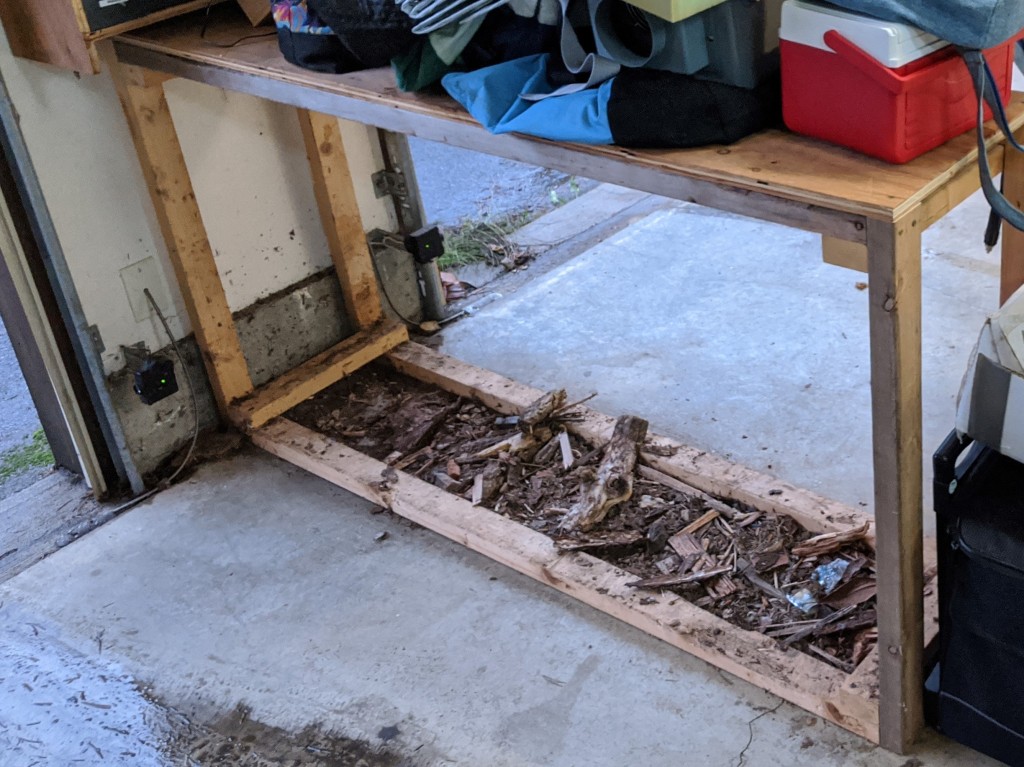
One of several empty firewood bins
A senior couple in Newport has opened their house to me, friends, and relatives for years. They’ve generously shared conversation, meals, and endless beverages. Last time I was visiting, I noted that their wood bins – all 4 of them – were bare. So I decided to split and stack the large pile of wood I’d seen covered and untouched in a year.
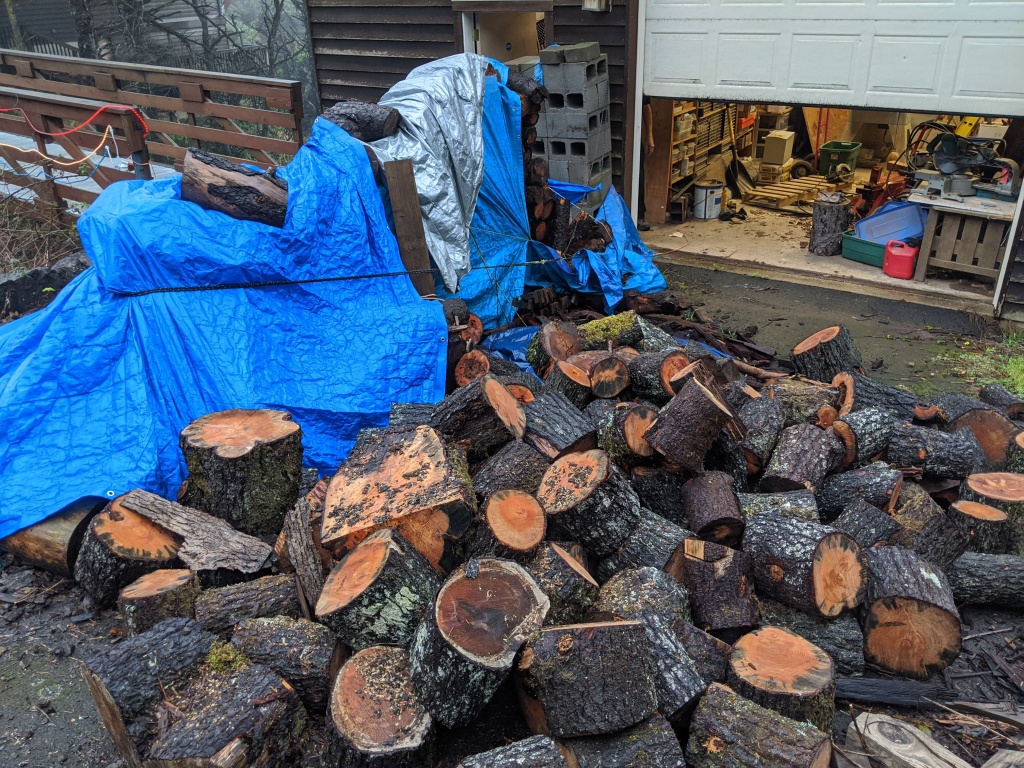
Firewood waiting to be split
Splitting wood takes me back to my years growing up. The house I was raised in was heated entirely by wood fire as was a fair amount of our hot water. We had three wood stoves: one in our basement, one in our living room, and one in our bath house. One daily chore was to haul wood and kindling up the stairs to keep our wood bin supplied, as well as to start a wood fire in our living room fireplace. The bath house stove heated the water used in our kitchen, and its tall, narrow shape and relatively small opening required small pieces of firewood.
Countless days and weeks were spent sawing logs and splitting wood. Living on the beach, logs sometimes washed ashore. Out would come the chainsaws, wedges, and splitting mauls. Sometimes we’d spy logs floating in the bay, and we’d take a rowboat or kayak out, pound a spike into it, tie it with a rope, and tow it to shore to be cut and split.
The beach in front of my childhood home with concrete sea walls to protect against storm waves
The smell of fresh-cut wood, and the satisfying crack and creaking sounds of wood fibers being wrested apart, the pounding of my heart, and the dripping sweat on my brow bring back vivid memories from childhood of so many cords of wood cut, split, stacked, carried, and burned.
I also have vivid memories of wedges stuck in recalcitrant stumps, and the pounding of splitting mauls and sledge hammers, and the prying with bars and a peavay required to free them.
A quiet, efficient power splitter
Happily, my friends had an electric power splitter. What an amazing a satisfying device! It was quiet and easily sliced through stumps filled with knots. No lifting and swinging an axe, splitting maul, or sledge hammer! So the majority of the physical labor was simply feeding the splitter, then removing and stacking the split wood.
Serendipitously, a couple of other friends had contacted me about some dried, cured, and cut firewood they needed to get rid of. They agreed to meet me in Newport, unload their truckload of wood, and help with the stacking and splitting.
A group of six of us (including an amazingly energetic and agile octogenarian) made quick work of the sizable task, and we finished after about 5 hours of work.
Sun breaks during the first day of the new year
Although the weather forecast threatened 90% chance of rain and winds 15-25 mph, no raindrops fell and the wind was breezy, but mild. The sun even broke through momentarily, and the temperature remained right around 50 degrees, which was perfect for the strenuous labor.
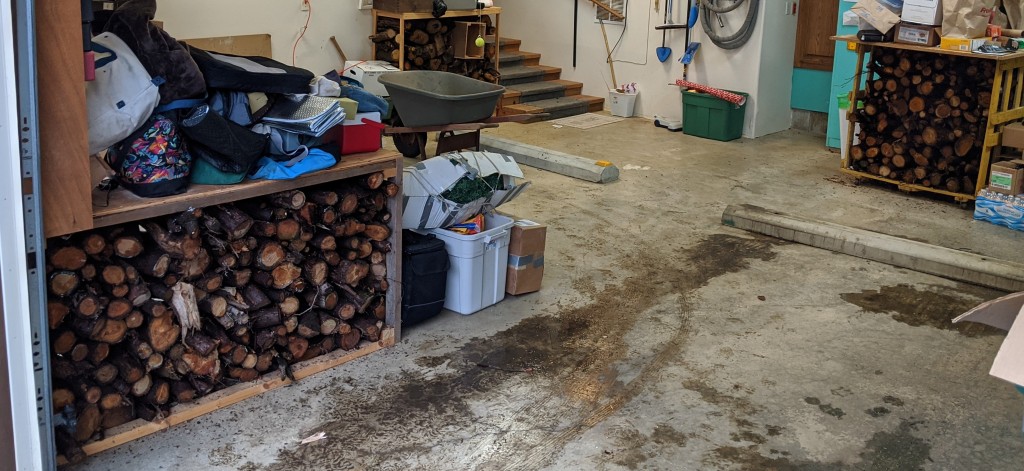
Three firewood bins filled, courtesy of my friends’ delivery
My coastal friends were delighted to have a huge supply of fresh, dry firewood – probably enough to last at least two winters. There still is some wood left to split and stack, and I intend to finish that task myself the next couple times I come to the coast.
Freshly split and stacked firewood, about 6 feet tall and 5 feed wide, and three levels deep
Some good physical labor and working together with friends to help some seniors feels like an auspicious way to bring in the new year. I am hopeful and optimistic for 2020, and hope you are as well.
Finland is putting effort into combating fake news online. It started doing so way back in 2015, when President Sauli Niinisto called on all Finns to take responsibility in fighting false information. They are teaching school children, college students, adults, and seniors how to spot false online information and to develop skills in critical thinking and investigation.
Finland has only been an independent country for 101 years, and it shares an 832-mile border with Russia. During that century, Finland has had to deal with decades of propaganda from the Kremlin. During World War II, Finland surprised and repulsed the much greater and more heavily armed invading Soviet forces in the Winter War.
Finnish machine gun crew resisting the Soviet invasion during WWII
In a relatively short period time Finland has catapulted from a mostly agrarian country to one of the most literate and technologically advanced countries in the world. It routinely places tops in the world for the quality of its education system, a system which eschews standardized tests and marketplace competition, is completely publicly funded, and has the smallest differences between the weakest and strongest students in the world.
The new Finnish PM (3rd from left), Sanna Marin, and three of her cabinet members, all under 40 years of age.
Finland and her people occupy a special place in my heart as I was exchange student there one summer as a high school student. I still stay in touch with many dear and close Finnish friends. That Finland is successfully leading against this new technological propaganda front does not surprise me.
“Death, Sex & Money” podcast host, Anna Sale interviewing mom at Heart Mountain
Last summer, I twisted my mom’s arm into coming to the 2019 Heart Mountain Pilgrimage, site of one of two “camps” she and her family were incarcerated in during WWII. I just posted a little about the pilgrimage on my other blog.
One podcast I love and am subscribed to is “Death, Sex & Money” from WNYC and hosted by Anna Sale. I happened to see Anna and introduced myself to her.
She ended up interviewing mom and included a clip of mom at the very end of her latest podcast episode “The Children Of Heart Mountain.” It is quite good and I recommend you listen to it.
If you are interested in learning more about this period of history, I recommend my “February 19, Day of Remembrance” post.
Update: This post was written long before the pandemic. Although things are opening up, I remain cautious and have been hosting karaoke parties online, which you can read about here.
Last night I attended a karaoke birthday party for the daughter of one of my high school friends. Anyone who knows me knows that I love to sing karaoke. I even got to sing karaoke in its country of origin, Japan, a few years ago.
I met the birthday girl’s siblings, a cousin, and a friend, and an evening of joyful song and harmonies ensued. I found it especially heart-warming to see siblings and mother happily singing together in harmony.
I have written why I like karaoke (I used to avoid it) and want to share that essay again here.
Learning to Love Karaoke By Toby Loftus, 2017
I sing karaoke. A lot. Nearly once a week finds me in any of a number of area karaoke bars singing with friends. I recently sang karaoke in Japan, and thus checked one item off my bucket list. I was not always so enamored with karaoke. Indeed, like many, I used to avoid karaoke and thought poorly of those who partook. This is the story of my journey from resistance and judgement to enthusiastic embrace and evangelism.
What possesses a person to get up in front of strangers, many possibly inebriated, and sing (or at least make an attempt)? When I was younger, I supposed it was a need for attention, and, knowing my own predilection for the spotlight – often to hide my insecurity at the cost of more deep, vulnerable connection with others – my resistance to taking part was pretty firm and automatic. I judged the karaoke aficionado similar to the person who thinks, incorrectly, they are funny and entertaining while commandeering a mic – much to everyone’s great dread and discomfort.
Part of my resistance was due to my identity as a musician. Classically trained, starting at age four to play the violin and other instruments subsequently, I’ve never had any vocal instruction save for a couple years in junior high choir. I can carry a melody and know when I’m out of tune, but I’ve never considered myself a singer, really. As comfortable and versatile I may feel with a viola under my chin, I’ve never had that level of comfort with my own voice. Sometimes things come out of my voice I don’t intend, and like most people, I shudder with discomfort when I hear recordings of my own voice. There is something really unvarnished about singing, and doing so, especially in front of strangers, can feel like standing alone, naked and vulnerable.
When I was a kid, my father loved to have sing-a-long parties. He collected sheet music of old pop tunes from the 30s and 40s. He mimeographed pages of song lyrics and made makeshift song booklets. He was always trying to get a group of people to sing these old songs. I never fully understood the appeal, but I went along with it. Sometimes as a family we’d sing some old turn-of-the-century songs in 4-part harmony. I liked that, just as I liked playing string quartets and block flute duets and trios. Playing string quartets is, to this day, one of my favorite activities, and I’ve added my own compositions and arrangements to a growing library of quartet music I enjoy reading with friends.
I do like to sing by myself, and I often rewrite song lyrics for fun. Since Christmas carols are played repeatedly for weeks, if not months before December, I’m usually so sick of them that changing the lyrics in my head is one way I amuse myself and maintain my sanity. I have also played in the pit orchestra for musicals. By the end of the many rehearsals and shows, everyone knows every song lyric and line. So I’ll rewrite the lyrics to amuse myself and my fellow musicians and actors. I also like to choose a favorite song and rewrite the lyrics for birthdays, anniversaries, and other special occasions for friends. In all, I’ve probably rewritten over three dozen song lyrics. But singing alone, or singing for or with friends is different than karaoke. It’s safe, and fun, whereas a karaoke setting is quite another thing.
My first karaoke experience happened several years ago. My eldest brother loves to sing karaoke and celebrated a birthday with a party in a private karaoke suite. I decided to get up and sing a Sinatra tune. It didn’t go badly, and it wasn’t unpleasant. Maybe there was something else about this I was missing.
Another time, during a weekend where I was performing with the Newport Symphony, some acquaintances suggested some after-concert karaoke at a local dive bar. Okay, I decided to give it a try. As I entered the bar in my tuxedo, all eyes were upon me as I looked for my friends. I took a deep breath and walked through the bar as confidently as I could, finally locating them in an adjacent room. My friend, Melissa, was so enthusiastic and encouraging, I couldn’t help but be disarmed of some of my judgement and insecurity, and so I got up and sang, appropriately, “Sharp Dressed Man” and got a rousing ovation from the locals. That was kinda fun!
I started doing this regularly in Newport, coaxing fellow musicians into joining me. We became regulars, recognized and enthusiastically received by the locals and the KJ of the Newport bar whenever we’d show up. I loved getting to see and hear my musician friends sing. The surprise of hearing their voices and seeing what songs and genres they would choose was far removed from the relatively narrow genre of symphonic music I had previously played and associated with them.
At the beginning of 2017, I decided I wanted to play more chamber music, and I wanted to sing more karaoke. I now have in my car a USB drive containing the Billboard top hits from 1946-2004 which I regularly listen to, finding songs to add to my list of possible karaoke tunes. I have created a Facebook page with a growing number of members, some of whom get together every week or so – sometimes even more frequently – to sing karaoke.
So why, why am now I so immersed in karaoke? I’ve thought a lot about this, and there are several reasons.
1. Expanding Musical Horizons As indicated previously, I am a classically trained musician. As a child I studied violin, piano, and flute. I took private lessons and performed often with my father. I grew up in a household with an extensive vinyl collection of classical, jazz, and folk music, but very little popular and rock music. I didn’t listen to any rock-n-roll (other than maybe some Beatles), and also no country and western music. It wasn’t until I was a sophomore in high school that I started listening to rock music and attending dances and parties. I didn’t attend my first rock concert until I was in college. So I was a late bloomer.
Also, I used to really detest country and western music. As I have often shared, my best friend in high school and I used to joke you could convert any song into country by just adding a “bare chicken” to it (“bare-chicka bare-chicka bare-chicka…” – you can often hear this rhythm in the drums on most country songs).
As I’ve listened to and watched people sing karaoke, I’ve come to really appreciate country and western music and have begun to sing a little myself. Other genres I have previously avoided, or only listened to, I now embrace and may sing (rap, Disney songs, show tunes, 70s and 60s pop, do-wop, etc.). I enjoy continuing to discover, rediscover, and find new joy and beauty in music I’d previously avoided or discarded.
2. Universal Acceptance and Support I have heard a lot of karaoke singing, some good, some great, some mediocre, and some pretty awful. But I have never heard a single “boo!” or heckle. It is good karaoke form to always clap and cheer on every singer, regardless of ability, and I see that every time. The very worst response I might have witnessed was a subdued golf clap, that’s it. Never anything negative.
What could be a more potentially antagonistic situation than a stranger, dressed in a tuxedo, walking into a dive bar to sing in front of local fisherman and townspeople? When I did it, they were enthusiastic and supportive of me. How about a diminutive school teacher getting up and singing a song in Spanish in front of the same group? People got up and danced while she sang!
In a time when it seems like everywhere one turns there is argument, ad hominem attack, polarization, and friction, seeing this kindness, enthusiasm, and universal positive acknowledgement and support really warms and heals my heart.
3. Overcoming Insecurity Nearly every person I know who sings has some insecurity about their voice. And I know some people who have amazing voices. I will never forget the first time my friend, Jennifer, got up to sing. She was tentative and had to be gently cajoled a bit to sing. Then she sang Whitney Houston’s “Saving All My Love.” My jaw hit the floor as she brought down the house. Recently, a friend, Chelsea, got up and sang Eartha Kitt, and the bar was mesmerized into silent awe. Several people told her she should try out for “The Voice” or other singing contest shows. The fellow who followed her proclaimed, “Chelsea, you’re great! I’m f***ed!” Everybody laughed, and he did fine.
I, myself have had to overcome my own insecurity about my voice. Like most, I probably could list all the things I don’t like about my voice, myself and what I am unable to do, and I would struggle to make a list of the positives. But people encourage me, just as I encourage others. I truly love to hear others sing and have to tell myself they may feel the same for me. It’s really delightful to see someone who has been tentative and fearful to sing, get up there, and gain confidence in the accolades they receive. It’s like watching a flower open up in full bloom.
4. Harmony and Healing In karaoke, I love to sing harmony with others. Whether it’s singing Kool and the Gang or Air Supply duets with Joe, “Stumblin’ In” with Lisa, “You Don’t Bring Me Flowers” with Jennifer, “Islands in the Stream” with Rochelle, “Suddenly Seymour” with Alicia, or “Elvira” with Eric and Joe, there’s something really magical about harmonizing with someone else. Like playing string quartets, I delight in listening to and responding to others musically, supporting and being supported by them. I used to be an avid ballroom dancer, and a good duet feels as joyful and uplifting as a really well executed waltz.
The late film critic, Gene Siskel famously loved the movie “Saturday Night Fever,” so much so that he reportedly watched it 27 times and bought Travolta’s white disco jumpsuit at an auction. In a 1993 “Our Favorite Scenes” special on Siskel & Ebert, Siskel calls out the “Night Fever” routine from the movie:
As the Bee Gees music builds, these quarreling kids are brought together by the music…The music is healing as the ‘Night Fever’ dance number turns into a dream of what might be if young people could learn to dance with each other off the floor as well…What could be a better dance scene than one that shows dance as capable of bringing about…a reverie of peace?
Indeed. I’ve always believed there was much more commonality between people than difference. Singing together reaffirms this belief in my mind and in my heart. I look forward to my next karaoke session with friends, wondering who will come, what people will sing, and preparing my own song list. After a karaoke session, my feet float a little lighter with each step as I recall the songs sung, the laughs shared, and the deep feelings of joy and affection felt by and shared among my friends. It doesn’t even require one to sing; there are some friends who attend, but never never sing. They come cheer on others and dance to the music.
I cannot promise you will find the solace, healing, and communion I do in karaoke. But I encourage you to give it a try. And if you ever want to join me, you are always warmly invited.
And remember, my sentimental friend, that a heart is not judged by how much you love, but by how much you are loved by others.
The Wizard of Oz
I remember from an early age identifying with the Tin Man from “The Wizard of Oz.” This evening I feel like him.
Today was my last day at a company for which I have worked almost seven years. There were many kind words shared and hugs exchanged the last few days as I bid farewell to many wonderful people.
This evening I opened a book into which people had scribbled well wishes and farewells.
Reading what people have written fills my heart and dampens my eyes. I will turn to this book whenever I struggle and need a boost.
May I be so fortunate to continue to meaningfully connect with colleagues and clients, share and receive kindness, generosity, and compassion, and make a lasting difference,
The days are growing shorter, colder, and darker. My early morning commute has offered me some spectacular images over the last week or so. Here are a few.
The number of times I have played music for a non-human audience I can count on one hand. It appears, however, that music may well move our animal fellows in ways similar to how it moves us.
While in Pendleton to perform with the Oregon East Symphony, I stayed with my friend, Emily. Here is Emily’s dog paying attention to me while I played her piano.
I was warmly rewarded for my efforts.
My friend, Hamid is a skilled healer and musician with whom I’ve enjoyed jamming on a few occasions. While we were playing, his dogs came in and disrupted our music with kisses and attempts to sit in our laps.
I enjoyed visiting my friend, Erin and her menagerie of animals. I spied a piano and sat down, which seemed to delight her cockatoo, Raspberry.
Watch closely to see us bobbing our heads at each other.
I’m not in these videos, but my friend, Jenny has a sweet dog, Buddy, who sings when she plays the violin. I love revisiting these videos often.
British Channel 4 hosted an election debate on climate change last Thursday. Prime Minster Boris Johnson and Brexit Party leader Nigel Farange declined to attend. The channel chose to represent them at their empty podiums with ice sculptures.
These two ice sculptures – which represent the emergency on planet earth – will take the place of Boris Johnson and Nigel Farage tonight after they declined our invitation to attend a party leaders' #ClimateDebate
My first reaction was to laugh out loud at the absurdity of this outrage. But given the direct attacks on journalism launched by politicians here and abroad and actual cases where journalists have been imprisoned, deported, or physically attacked, my laughter is quickly silenced.










 Blatant Calm
